
"Door county cherry growing primarily a family enterprise" from the August 3, 1978 Door County Advocate
By JOHN ENIGL
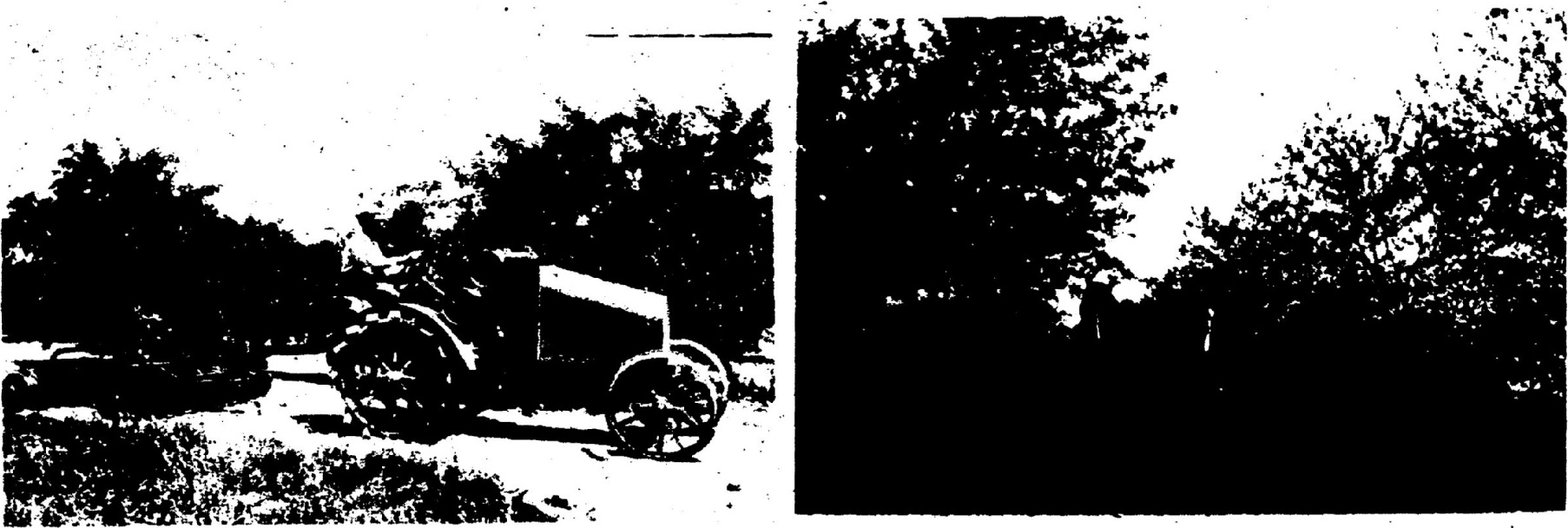
Early days of cherry growing show Fred G. Berger disking his father's Jacksonport orchard with an International 8-16 at left and Fred Berger Sr. cultivating with team at right.
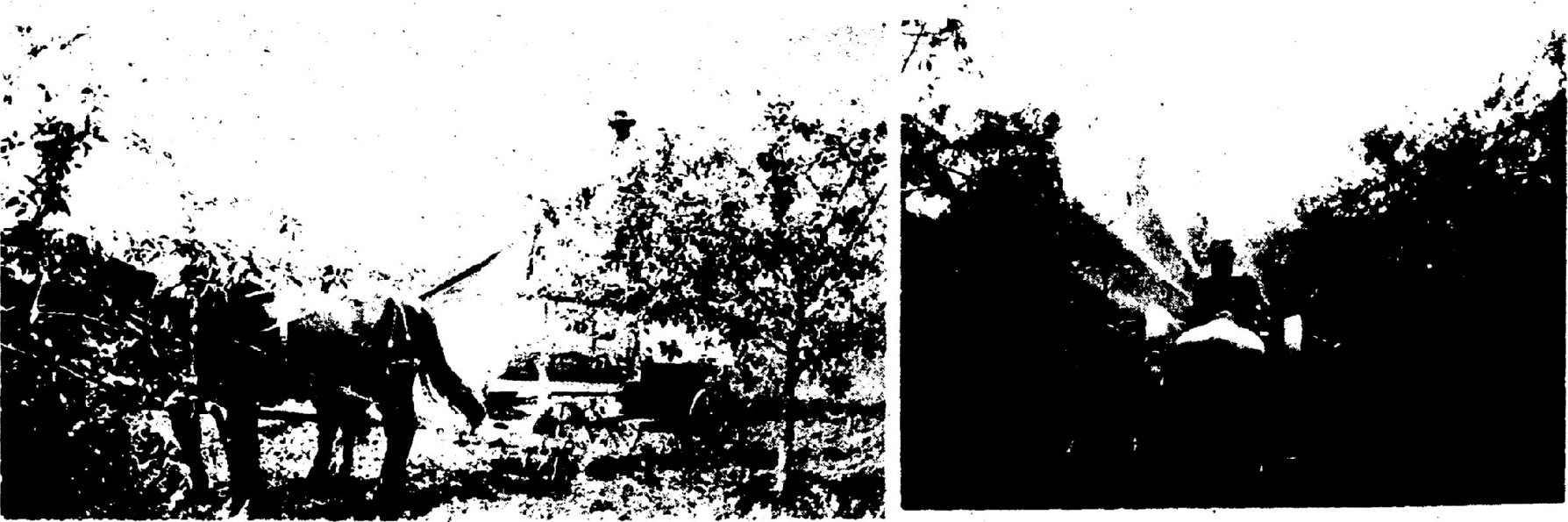
A team drawn sprayer was used to spray cherry trees in the early life of the Fred Berger orchard at Jacksonport but now Joseph Kuehn uses a tractor drawn rig to spray Mrs. Gerald Carmody's orchard.
Door county cherry growing primarily a family enterprise
By JOHN ENIGL
PART I
As we go through another cherry season, it strikes me that, in many cases, our Door county cherry industry is still largely a "Ma and Pa" type of business.
This can be proven by citing such examples as that of Jim and Elsbeth Knutson of Nasewaupee. Jim takes time out of his thriving insurance business to harvest his crop. A news editor named James Robertson. who writes a column under the pseudonym, "Orchard Ole," is a real life cherry grower, aided by his wife, Eileen.
In the case of our family. which has been a small part of the cherry orchard business since 1925, it has always been a family affair and one where each member has had to do his share.
This "Ma And Pa" or family type operation extends beyond the growers, however, into other facets of the cherry industry, as I shall show later.
The cherry story started in Door county around the turn of the century. The cast of characters involved in this scenario has slowly changed over the years. It has retained some of the original families involved and even retained some of the original members of the cast.
For example, Art Abramson has been raising cherries since 1910 and although in his 80's he still cares for his orchard on S. Duluth av. He has it picked by machine now but still does the rest of the work in the 300 tree plat. His house has had to be moved twice because of highway improvement but he takes progress in stride.
Quick to smile and joke, as does his wife, they attended the party given by the Ramstacks for the Chico growers on July 8 at Mr. G's. They don't talk about giving up the orchard but instead look forward to this year's crop and those in the future.
Fred Berger of Carlsville, now 82, was part of a Jacksonport cherry growing family. The Bergers, too, got into the cherry orchard business about 1910.
Fortunately for those of us of later generations, Fred Berger took many photographs of early Jacksonport. He has agreed to allow some of them to be used in this and future stories.
One remarkably clear picture taken and developed by Fred Berger shows his father working their orchard during blossom time with a team of horses. Examining the picture closely, we can see how they were able to cultivate so close to the trees that there are hardly any weeds even right next to the trunk. There is a set of drag teeth at the right of the picture but none on the left side. When the long board that was fastened to the drag teeth touched the tree trunk, it acted as what we today would call a "sensor." The drag teeth were automatically shunted away from the trunk of the tree to avoid injuring it. When the horses pulled the device past the trunk. the drag moved back to its former position, pulling the weeds right up to the next trunk.
Will Mitchell and Charley Sollenberger had a demonstration of a device up at their Egg Harbor Orchards that will do the same thing but it costs around $3000. It, too, has a sensor, an electronic one, that allows cultivating right up to the trunk of the tree. But the inventiveness of orchard families like the Bergers allowed them to accomplish the same thing with the materials they already had on hand.
Another picture shows the younger Berger using one of Jacksonport's first tractors to work the family orchard. It was an International 8-16. My reference, Farm Tractors In Color (Macmillan, 1974) dates this as a 1919 model.
In addition there is a picture of a horse-drawn Meyers sprayer. The driver had to handle the reins and hand gun, too.
My old Meyers, purchased from Al Kroll for $100 many years ago. sits behind the shop, rusting away. We used it until 1963. The engine, first a one cylinder, had a 1926 Chevrolet replacement later in its life. When we couldn't get parts for that engine any more we replaced it with a Model A Ford engine. Parts for that one would be available right today, because of the popularity of Model A's as antique cars.
I recall pleasantly the years I helped the Albert Kroll family spray their orchard with the old two-gun Meyers. Al's life was cut short when he was in the 50's, ending the Kroll involvement in the orchard business. But I'll never forget those good meals we had, prepared by Marie, Al's wife. "Those were the good days." Marie says. Ironically, the well-known County League ball player was being buried at the same time another good man, John F. Kennedy, was entering the last hour of his life. The good are not always rewarded by a long life on earth.
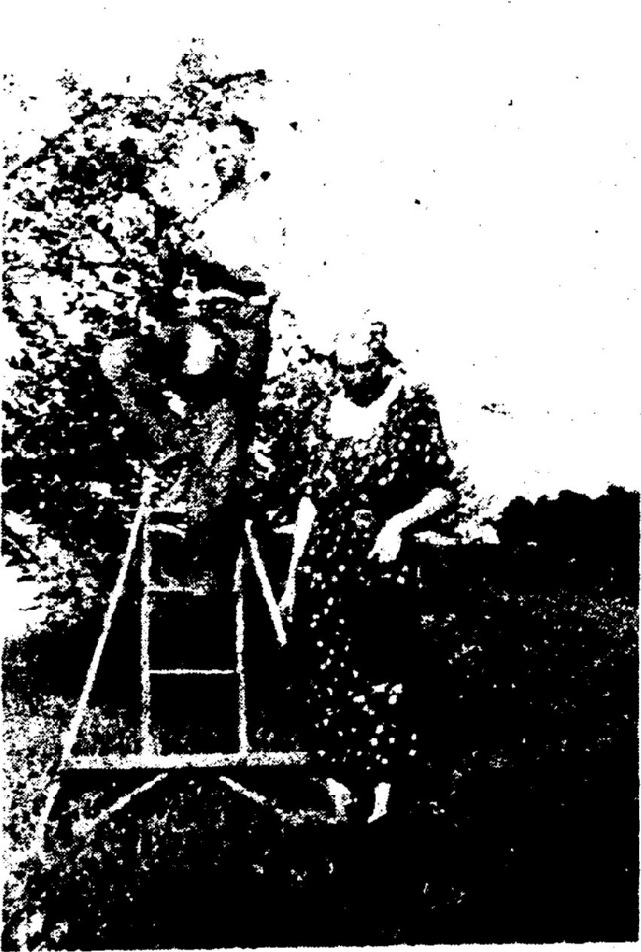
The author, John Enigl, and his aunt, Ingo Bavry Mueller, hand picking cherries in 1939.
Another family well known in the cherry industry are the Kuehns.
I shot a picture of Joe Kuehn spraying the orchard of his sister, Mrs. Gerald (Emma) Carmody, north of Carlsville. Gerald and Emma planted the little plot of cherries in the early 50's as a sideline of their dairy farm.
Gerald was a neighbor to us and a good one. Irish and Belgian, he took on the ways of his well-known thresherman father, Albert Carmody. The many of us who knew him will never forget how he wouldn't just say "Yes" if he agreed with you but would say emphatically "Well, I guess so! " and, "Yes sir! Yes sir!"
I suppose Gerald put in a few cherry trees because nearly everyone else had some. He didn't have a lot of extra time because he worked in the shipyard, too.
Then in the summer of 1965, Gerald, after hardly ever being sick in his life, entered the hospital because of pain in the abdomen.
I hadn't been in a hospital since they started putting the plastic tags on patients' wrists. a new procedure at that time. I asked Gerald what the tag was for.
"That's so Stoneman's will known who I am," he replied, half joking as usual, half deadly serious. (Stoneman's was a funeral home of the time.)
A few days later Gerald was dead, at 59.
However, the cherry trees remained as the only part of the farm Mrs. Carmody still operates, a reminder of the happy days of long ago. For her, it is a time when relatives get together to help her with the harvest, still hand picking, as it was when Gerald was alive.
Joe Kuehn is a much honored dairy farmer, subject of an article in the Wisconsin Agriculturist and numerous articles in the Advocate. I asked him about his orchard.
"We started our orchard about 1926. My father John and uncle Otto had orchards across the road from each other. We had 22 acres of cherries when our orchard was at its largest.
"Nearly all our orchard is gone now, except for a few hundred trees near the house. We're thinking of getting rid of those. But with the price of cherries today, we may put in some more."
Paul Kuehn was a brother of John and Otto and a colorful person that those who knew him will never forget. More jovial and talkative than his other brothers, he had a slight German accent, as did his wife, Lizzy. Always there was a friendly greeting when you visited them.
I remember one day in spring of 1945. I was working the plot of cherry trees we had just planted about 7:30 in the morning and I saw a cloud of smoke off to the north. Later. I found that Paul Kuehn's house had burned to the ground. He had saved little but his beloved violin.
But from then on, his fortunes changed. He bought a vacant house, moved it many miles to the farm, and turned the place into one of the cutest little cherry farms you want to see.
For a long, long time the good Lord smiled on Paul and Lizzie and gave them good crops of cherries, which became their only means of support. It was a happy comeback from the fire that had taken almost everything they owned.
Until just a few years ago, the Fred Fleischman family operated a cherry orchard where Park du Chateau subdivision is today. Here was a case of a very old couple operating a successful business. They always fixed up the garage for migrant Mexicans to stay. The quarters weren't fancy but they were clean. Their son, Milton, worked the orchard in the last years and hauled the cherries to the factory.
I spent plenty of time over at the Fleischmans, since my future wife was a sister of Milton's wife. I often think that the Fleischmans did pretty well, considering this was their only way of making a living.
When restrictions on migrant camps became too severe, Milton Fleischman bought one of the first limb shakers, a prototype built by Lloyd Londo. However, Milton found it was too hard on him physically so he had to sell it.
It wasn't long afterward that the Fleischmans sold their orchard.
I grew up with cherries. The first crop I can remember was the one of 1932, when we got one cent a pound for cherries and three cents a pail for picking.
Then there was the 1936 crop, when the only cherries anyone had were the ones that had been covered by snow during the cold winter before. (Lake Michigan froze over all the way across a year before that.) I can still remember those lower branches, the only red part of the tree.
We don't advertise for pick-your-owns now, but we did in the 1930's, when the money we got from cherries was sometimes all we had to pay the taxes.
We'd get some interesting customers, too. One man introduced himself as the father of the tallest man in the world, Clifford Thompson. He told us his son was 8'7". (Actual measurements from photos showed him to be 7' 5".)
Once, in the 1930's, when times were hard, a man came into the orchard and ordered a truckload of cherries picked on stem, to be sold fresh.
When the man came back, he didn't have any money. He was going to pay us "when he sold them."
My dad told him we couldn't deal that way, so he left.
We were up half the night picking off the stems so they could be taken to Reynolds.
My dad and I planted about 500 trees in 1945, and 500 more in 1952, in 10 acres. The usual ratio in those days was 100 trees to the acre.
In 1957, when our parents died, my brother and I inherited the farm and orchard. My brother had no liking for farming or orchard work so I bought him out. My future wife, Mary Ann, urged me to buy the property.
When we were married in 1958, we planned on taking care of the orchard and having Reynolds come in with a migrant crew to pick it.
When we came back from our honeymoon out West, we heard that the price was only going to be four cents a pound, and Reynolds charged four cents a pound for picking. Therefore, we would make nothing for our efforts.
We decided the only way we could make any money on the cherries was to get a crew and pick them ourselves.
Sarah and Marvin Daubner were in the last years of production of their orchard before they were going to cut down the trees. Since they didn't have a full season's work for their pickers, they offered to tell their pickers to come to our orchard after they were done.
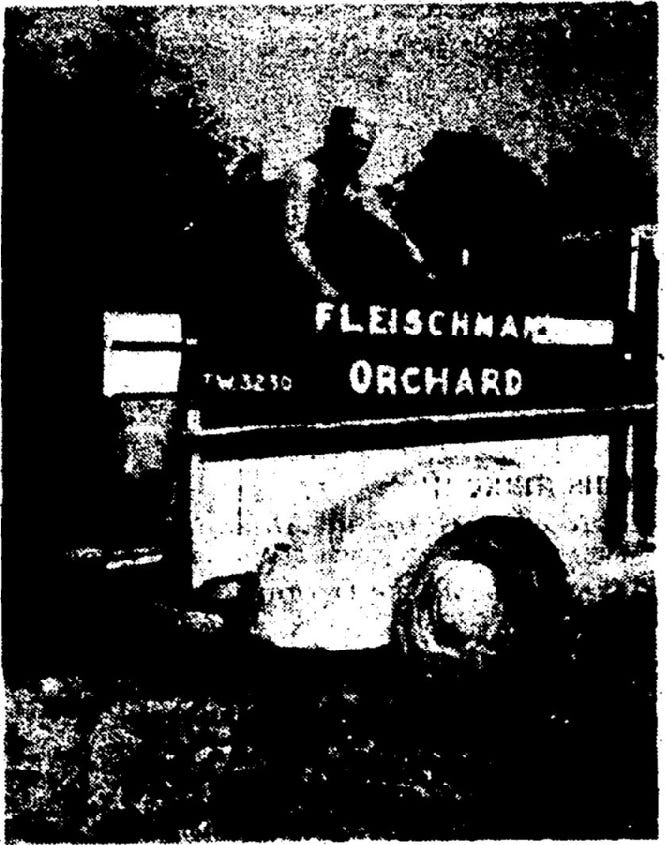
The late Milton Fleischman carried on the family orchard until it was developed into a west side subdivision.
The Daubners taught us much of what we know about handling a fairly large orchard crew. Our first orchard was only three acres in size: the picking was done by our family and relatives. My parents didn't live long enough to reap much benefit from the larger orchard. However, they were still living when we became acquainted with the Indian families who still help us in the cherry harvest today.
Since then, our six children have had a taste of orchard life they will never forget. From spending the first week of his life in the orchard, (as son John did,) to fixing cherry boxes, working, fertilizing and spraying the orchard, and picking, and shaking, they have seen every facet of the grower's life.
They have also seen the other parts of this Door county cherry industry that are family affairs, as I shall tell about in the second part of this story. Next time we will take a trip to the "family affair" cherry processing plants.
Courtesy of the Door County Library Newspaper Archive